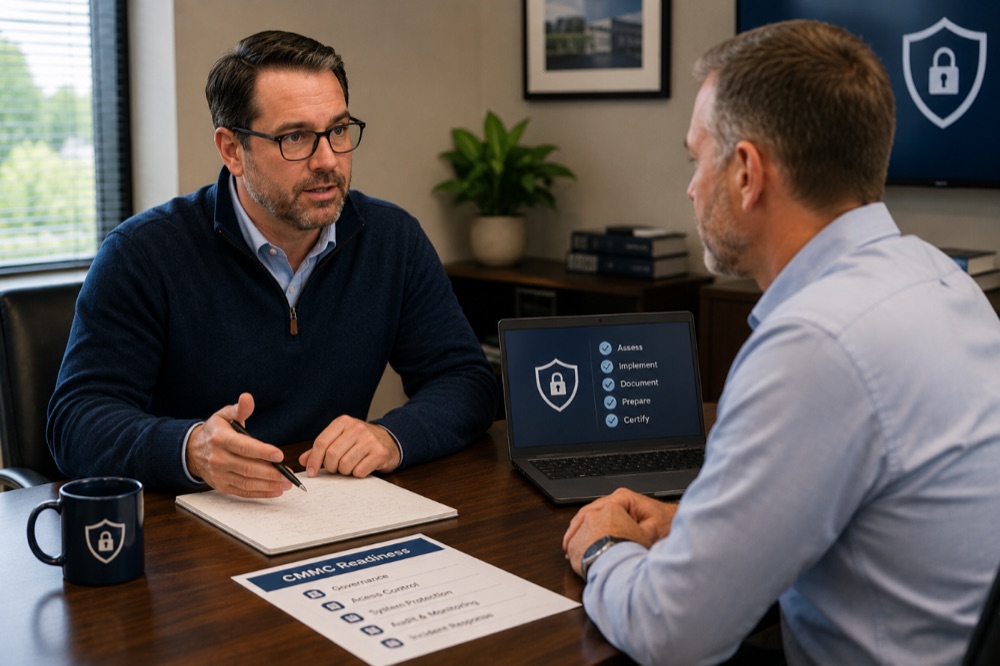
Choosing an IT partner for CMMC certification is one of the most consequential decisions a defense contractor makes in the compliance process. The right partner shortens your timeline, keeps your preparation accurate, and gets you to certification without surprises. The wrong partner costs you time, money, and in some cases your certification itself.
The challenge is that the market is full of providers claiming CMMC expertise, and not all of those claims are equally substantiated. As demand for CMMC support has grown alongside the rollout of compliance requirements, the number of vendors positioning themselves as CMMC specialists has grown with it. Sorting through those claims to find a partner with genuine depth requires asking the right questions and knowing what credible answers look like.
This guide gives you a practical framework for evaluating any IT partner you are considering for CMMC certification support, along with the specific qualities that distinguish partners who will genuinely help from those who will not.
Quick Summary
- CMMC certification support requires a partner with specific compliance expertise, not just general IT capabilities
- The questions you ask during the evaluation process reveal far more about a partner’s actual depth than their marketing materials do
- Red flags in partner evaluations are as important as positive indicators and should be taken seriously
- Experience with defense contractors and regulated industries specifically is a stronger signal than general cybersecurity credentials
Table of Contents
- Why Choosing the Wrong Partner Is Costly
- The Three Types of Providers You Will Encounter
- Questions That Reveal Genuine CMMC Depth
- What Strong Answers Actually Sound Like
- Red Flags to Watch for During Evaluation
- The Qualities That Distinguish the Best Partners
- How Mindcore Technologies Stands Apart
- Make the Right Choice Before the Timeline Pressures You
Why Choosing the Wrong Partner Is Costly
The cost of choosing the wrong IT partner for CMMC certification is not always immediately visible. It often shows up later in the process, when gaps that should have been identified during the initial assessment surface during the internal readiness review, or when documentation that was built with insufficient expertise does not hold up to assessor scrutiny, or when the formal assessment produces findings that a better-prepared program would have avoided.
Remediation under those circumstances is expensive in multiple dimensions. There is the direct cost of fixing the gaps and rebuilding the documentation. There is the time cost of delaying the formal assessment while remediation happens. And there is the business cost of a compliance timeline that slips past a contract renewal date or a prime contractor’s requirement, putting revenue at risk.
Beyond the financial cost, there is the frustration of having invested significantly in a process that did not produce the outcome it promised, and having to start over with a different partner under time pressure that did not exist when the original engagement began.
The time spent evaluating partners carefully before committing is always less than the time required to recover from a poor choice after the engagement is underway.
The Three Types of Providers You Will Encounter
As you evaluate potential IT partners for CMMC support, you will generally encounter three types of providers, and distinguishing between them saves significant time in the selection process.
The first type is the general IT services provider that has added CMMC language to their website in response to market demand. These providers may have solid technical capabilities in areas like network management, endpoint protection, and help desk support, but their CMMC expertise is surface-level at best. They understand the framework conceptually but have not guided organizations through the assessment process and cannot anticipate the specific issues that arise in practice.
The second type is the compliance consultant or advisory firm that understands the CMMC framework in detail but has limited technical implementation capability. These providers can tell you what you need to do but struggle to help you actually do it. They are most useful as a supplementary resource alongside a strong technical partner, not as a primary CMMC support provider.
The third type is the integrated cybersecurity and IT services provider with genuine CMMC depth across both the technical and compliance dimensions. These providers have guided organizations through the full preparation and assessment process, have direct experience with the specific issues that arise in each phase, and can deliver both the implementation and the documentation support that certification requires. They are the partners worth engaging.
Questions That Reveal Genuine CMMC Depth
The questions you ask during partner evaluation are your most powerful tool for distinguishing genuine expertise from well-packaged claims. The following questions are specifically designed to surface the depth and relevance of a provider’s actual CMMC experience.
How many organizations have you guided through a completed CMMC Level 2 assessment?
This question separates providers who have supported the full process from those who have helped with preparation but not seen organizations through to a formal assessment outcome. A credible answer includes specific numbers and ideally references from organizations that completed the process successfully.
What were the most common gaps you identified during gap analyses for defense contractors in our industry?
A provider with genuine experience will have specific, pattern-based answers to this question drawn from real engagements. A provider without real depth will give generic answers that apply equally to any industry or any certification level.
How do you handle documentation maintenance between the initial certification and the three-year reassessment?
This question tests whether a provider understands that CMMC compliance is ongoing rather than a one-time project. Providers with genuine depth have a structured answer. Providers without it often treat this as an afterthought.
How do you prepare staff for the personnel interview component of the assessment?
The personnel interview is a standard part of formal CMMC assessments, and many organizations underperform in this area due to inadequate preparation. A provider who has genuinely guided organizations through assessments will have a specific, practical approach to this preparation.
What happens if we discover a significant gap late in the preparation process?
This question tests how a provider manages realistic complications. Good answers describe a structured remediation process, a clear understanding of POA&M options, and experience managing timeline implications. Evasive answers suggest the provider has not actually navigated this situation in practice.
What Strong Answers Actually Sound Like
Strong answers to the questions above share several qualities. They are specific rather than general. They reference real situations and real outcomes rather than describing what the process should ideally look like. They acknowledge complexity and describe how the provider navigates it rather than minimizing it. And they demonstrate familiarity with the assessment process from the assessor’s perspective, not just the contractor’s.
A provider who says they have guided twelve defense contractors through completed Level 2 assessments and can describe the three most common gaps they encountered across those engagements is giving you a credible, experience-based answer. A provider who says they have extensive CMMC expertise and describes the process in terms that match the framework documentation without adding any insight from real engagements is telling you they understand the theory but may not have the practice.
Red Flags to Watch for During Evaluation
Just as important as positive indicators are the red flags that signal a provider is not the right choice regardless of how their capabilities are presented.
A provider who promises a specific certification timeline without first conducting a thorough gap analysis of your environment is making a commitment they cannot keep. No credible provider can tell you how long your CMMC preparation will take before they know where you are starting from.
A provider who significantly underestimates the typical preparation timeline for Level 2 certification may be telling you what they think you want to hear rather than preparing you for the actual process. Level 2 certification typically takes six to twelve months from a reasonable starting posture, and providers who suggest the process is significantly shorter are either working with organizations that are unusually well-prepared already or are not giving you an accurate picture.
A provider who cannot clearly explain the difference between self-attestation and C3PAO assessment, or who conflates NIST 800-171 compliance with CMMC certification, lacks the foundational knowledge required to guide your program effectively.
A provider who does not ask detailed questions about your specific environment, your contract requirements, your current compliance posture, and your timeline before proposing an engagement is not doing the work required to give you a meaningful proposal. Generic proposals are a signal of generic capability.
The Qualities That Distinguish the Best Partners
The IT partners who deliver the most value in CMMC certification engagements share a consistent set of qualities that go beyond credentials and experience claims.
They ask more questions than they answer in the initial engagement. The best partners are genuinely curious about your specific situation before they tell you anything about what you need.
They give honest assessments rather than optimistic ones. A partner who tells you what they observe in your environment, including the difficult parts, is giving you information you can act on. A partner who emphasizes the positives and minimizes the challenges is not preparing you for the actual process.
They have a structured methodology that they can explain clearly. The best partners do not approach each engagement differently based on feel. They have a repeatable process built from real experience that they apply consistently and adapt to your specific circumstances.
They maintain visibility into your compliance posture after certification. The best partners do not consider the engagement complete at the assessment. They build ongoing monitoring and maintenance support into their service model because they understand that certification is a continuous state, not a milestone.
How Mindcore Technologies Stands Apart
With the market for CMMC support crowded with providers of varying depth and credibility, finding a partner that delivers on all of the qualities described in this guide is genuinely rare. It is the standard that Mindcore Technologies has built over more than 30 years of cybersecurity and IT service delivery.
Under the leadership of Matt Rosenthal, CEO of Mindcore Technologies, the team brings direct experience across the full CMMC preparation and certification process, a structured methodology built from real engagement outcomes, and the integrated technical and compliance capabilities that defense contractors need in a single partner. Mindcore asks the right questions before proposing anything, gives honest assessments of where organizations actually stand, and builds compliance programs designed to sustain certification reliably over time rather than just achieve it once.
Their experience spans defense contractors, healthcare organizations, financial services firms, and other regulated industries, giving them a depth of compliance context that providers without that breadth cannot match.
Make the Right Choice Before the Timeline Pressures You
Partner selection decisions made under pressure produce worse outcomes than decisions made with adequate time for thorough evaluation. The contractors who choose the best partners for their CMMC programs are the ones who start the evaluation process early enough to ask the right questions, assess the answers carefully, and make a deliberate decision rather than a rushed one.
A free consultation with Mindcore Technologies is a low-commitment starting point for that evaluation. Come with the questions in this guide and see how the answers compare to what you hear from other providers.
Conclusion
Choosing the right IT partner for CMMC certification is not a decision to make based on price alone, proximity alone, or the confidence of a sales presentation alone. It requires asking specific questions, evaluating answers against the standard of real experience, and watching for the red flags that signal a provider is not as capable as they present themselves.
The contractors who get CMMC certification right the first time almost always credit their partner as a central factor in that outcome. With Mindcore Technologies and more than 30 years of cybersecurity and IT expertise behind your program, that outcome is what the engagement is built to produce.
About the Author
Matt Rosenthal is the CEO and President of Mindcore Technologies, a full-service IT consulting and cybersecurity firm serving defense contractors, healthcare organizations, financial services firms, and businesses across New Jersey, Florida, Maryland, South Carolina, Louisiana, Texas, and nationwide.
With more than 30 years of experience in IT leadership and cybersecurity, Matt has helped organizations of all sizes build secure, compliant, and scalable technology environments. He holds an MBA in Technology Management, is a certified Project Management Professional (PMP), and is the host of Digging In, a weekly podcast on success in business, life, and health.